
Are featherless chickens really GMO/genetically-engineered?

February 5th, 2012
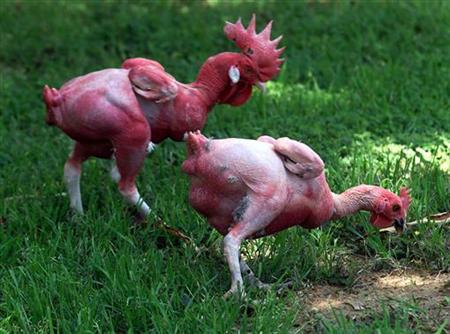
Are these GMO chickens? Genetically-engineered without feathers... naked, or are they actually just conventionally bred?
Genetic modification or just conventional breeding?

Pictures of these creepy new chickens are going around the web, claiming these are genetically modified organisms (GMO), however, it is reported that these chickens were created through conventional breeding by an Israeli scientist. They were bred using a bare-neck breed of chicken (likely what’s called the “turken“) that’s been around for decades, that was also conventionally bred. In other words, barring any newer mutations, these naked chickens theoretically could have been bred 3000 years ago with an intensive breeding program with no modern technologies.

Sure they look creepy, but so do naked mole rats and manatees, yet they are totally natural, and in the wild, not bred by humans at all.

The scientist does have some good points – this could be a good hot weather chicken and could do a little bit to impact the environment less.

Story on New Scientist: Featherless chicken creates a flap


World’s Longest Straw

February 1st, 2012

What is the longest drinking straw that you can actually drink out of? Well in this video, we put the theory to the test. We started off with a one metre long straw made out of drinking straws taped together. We moved on to two pieces of plastic tubing, each 6 metres in length with different diameters. Then we tried a 10.5 metre tube over a cliff’s edge. The maximum we achieved was about 7 metres though theoretically up to 10.3 metres is possible if a perfect vacuum is created.


Koala Encounters

January 15th, 2012

I saw my first wild koalas while driving on the great ocean road. Generally their days are not very exciting. They spend most of their time sleeping and the rest of the time eating eucalyptus leaves. The eucalyptus leaves are tough to digest which explains their consumate napping. Plus they require bacteria in their gut to help them break down their food. This bacteria must be passed down from mother to child through the mother’s poo. It’s a tough start to life for koalas!


What Is The Coastline Paradox?

January 7th, 2012

How long is the coastline of Australia? One estimate is that it’s about 12,500 km long. However the CIA world factbook puts the figure at more than double this, at over 25,700 km. How can there exist such different estimates for the same length of coastline? Well this is called the coastline paradox. Your estimate of how long the coastline is depends on the length of your measuring stick – the shorter the measuring stick the more detail you can capture and therefore the longer the coastline will be.


How To Make Graphene

December 19th, 2011

My entry to the techNyou Science Ambassadors competition, visit http://www.facebook.com/talkingtechnology and http://www.youtube.com/technyouvids to find out more about these guys.


What Causes The Phases Of The Moon?

December 12th, 2011

What causes the phases of the moon? The common incorrect answer is the shadow of the Earth. The phases of the moon are actually just a result of our perception of the moon’s half-illuminated surface. When the moon does pass through Earth’s shadow the result is a lunar eclipse. This can be spectacular as the moon turns a deep shade of red.

Images courtesy of NASAimages.org and Geoff Wyatt, Senior Astronomy Educator Powerhouse Museum


A Human Being Is A Part Of The Whole

December 3rd, 2011

A quote by Einstein: A human being is a part of the whole, called by us “Universe”, a part limited in time and space. He experiences himself, his thoughts and feelings as something separated from the rest — a kind of optical delusion of his consciousness. This delusion is a kind of prison for us, restricting us to our personal desires and to affection for a few persons nearest to us. Our task must be to free ourselves from this prison by widening our circle of compassion to embrace all living creatures and the whole of nature in its beauty. Nobody is able to achieve this completely, but the striving for such achievement is in itself a part of the liberation and a foundation for inner security.


Can You Go the Speed of Light?

November 1st, 2011

Einstein’s classic thought experiment involves sitting on a train travelling at the speed of light. If you hold a mirror in front of your face, will you see your reflection in a mirror? How could light from your face reach the mirror if the mirror is travelling away from you? But it would be a pretty spooky train if you couldn’t see your reflection so Einstein felt this solution wasn’t realistic. On the other hand if you could see your reflection, it would mean light was travelling at the speed of light inside the train. But that meant the same light observed from outside the train would be going twice the speed of light. This again seems inconsistent. So Einstein resolved that you must see your reflection but that light must travel at the same speed inside and outside the train. The only way this is possible is if space and time are perceived differently by observers inside and outside the train.


Nobel Prize Winner Brian Schmidt – Physics 2011

October 17th, 2011

The Nobel Prize for physics in 2011 was awarded to Brian Schmidt, Adam Riess, and Saul Perlmutter for discovering that the universe is expanding at an accelerating rate. This finding was completely unexpected because it was thought that gravity should slow the expansion of the cosmos. The best current explanation of why the universe is accelerating is that there is some energy tied to empty space which pushes matter apart. This ‘Dark Energy’ makes up 73% of the universe but is very difficult to detect. Hopefully a better understanding of it will lead to a unification of our theories of gravitation and quantum mechanics.

Images courtesy of NASA – NASAimages.org


Supersized Slow-Mo Slinky Drop

October 10th, 2011

What happens when a super long slinky is dropped?